 工業冷水機製造商 LNEYA Taiwan



Install a refrigeration unit for the circulating cooling water of the quenching tank
The quenching tank is a container filled with quenching medium. When the workpiece is immersed in the tank for cooling, it must be able to ensure that the workpiece is uniformly quenched at a reasonable cooling rate. It is a container that provides sufficient cooling capacity for the quenching of the workpiece to meet the technical requirements .
The quenching tank structure is relatively simple, mainly composed of tank body, medium input or discharge pipe, overflow tank, etc., and some are additionally equipped with heaters, coolers, stirrers and smoke exhaust fire prevention devices. The temperature of the quenching medium is one of the important factors affecting the quenching effect of the workpiece. Therefore, strictly controlling the temperature of the medium in the quenching tank is a measure to ensure the quality of heat treatment.
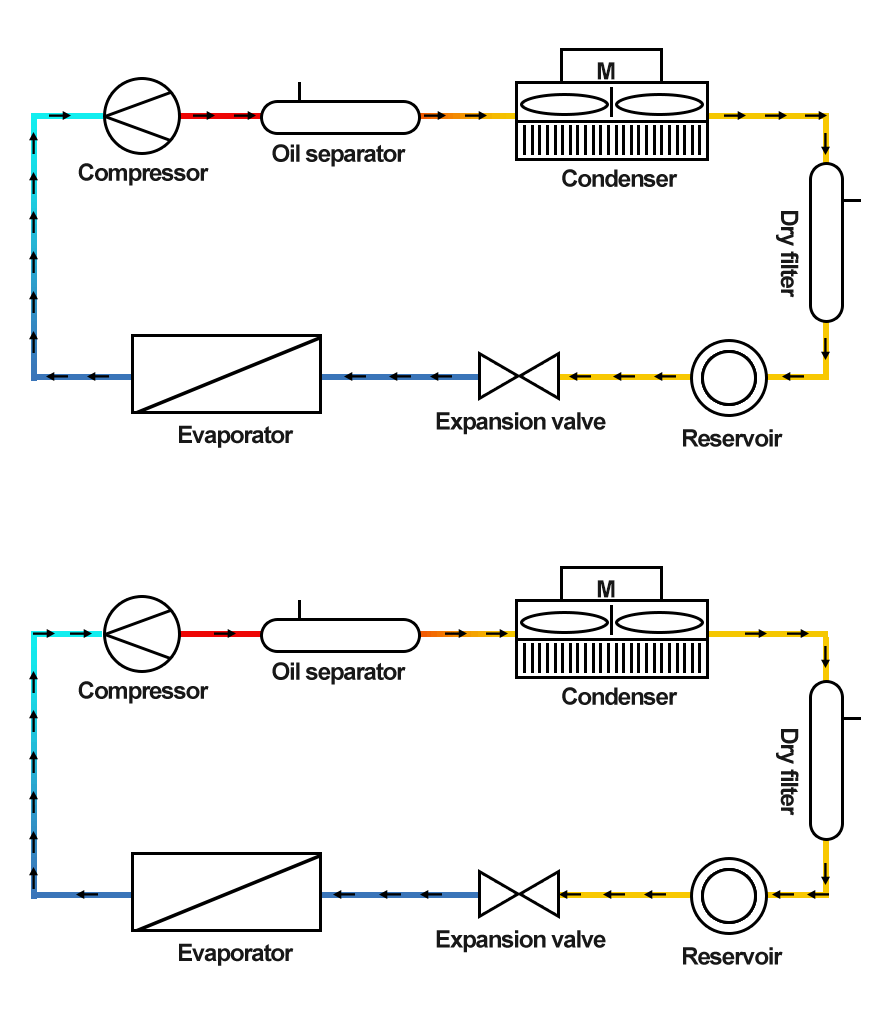
There are mainly three types of quenching tanks, oil tanks and bath tanks on the market. Here we mainly talk about the quenching tank. According to the cooling method, the water-cooling type has higher cooling efficiency, but because the temperature of the cooling water needs to be controlled, a sufficiently large cooling pool must be established. At the same time, the circulating cooling of the cooling water also requires the addition of a chiller unit to the quenching tank.
For large production batches, continuous production or large quenching tanks, the heated quenching medium is discharged into the cooling system for circulating cooling. Circulating replacement cooling water consumes a lot of resources, so additional refrigeration units are good news for manufacturers. The refrigeration temperature range of LNEYA cycle refrigeration unit is -150°C to -5°C, which can meet the needs of different refrigeration temperatures. The refrigeration speed is fast and can be frozen to -120°C within 3 minutes after stable operation. LNEYA provides equipment on-site installation and system testing. Users only need to complete the installation of refrigerant and cooling water.
Raccomandazioni correlate
-
Configuration form of circulating heating unit for laboratory
1883The standard model of the circulating heating unit for LNEYA laboratory is: SUNDI, the temperature range is from room temperature to minus 120 degrees Celsius, and the capacity can be divided into 5L, 10L, 20L, 30L, 40L, 50L, 80L, 100L, larger cap...
Visualizza dettagli -
Cause della riduzione dell'effetto di trasferimento del calore dei frigoriferi verticali a bassissima temperatura
1944Se lo strato di gelo esterno del frigorifero verticale a bassissima temperatura è troppo spesso o eccessivamente polveroso, la temperatura esterna dell'apparecchiatura può essere per lo più inferiore a 0, con conseguente bassa efficienza di trasferimento del calore...
Visualizza dettagli -

Quali sono le precauzioni per l'installazione di un refrigeratore a glicole?
2031In the summer, the use of glycol chillers is relatively frequent. Therefore, when installing glycol chillers, they need to be installed on a smooth and tidy floor. Why choose a smooth ground when installing? Users who have known the glycol chiller...
Visualizza dettagli -
Prima di avviare i refrigeratori industriali, è necessario eseguire i seguenti lavori
19512. For the compressor unit with water system, carefully check whether the cooling water system and chilled water system have water, and whether the water pressure is normal, whether the pipeline system of cooling water and chilled water is unblock...
Visualizza dettagli