 工業冷水機製造商 LNEYA Taiwan



Scelta del refrigeratore a bassissima temperatura per il reattore in vetro
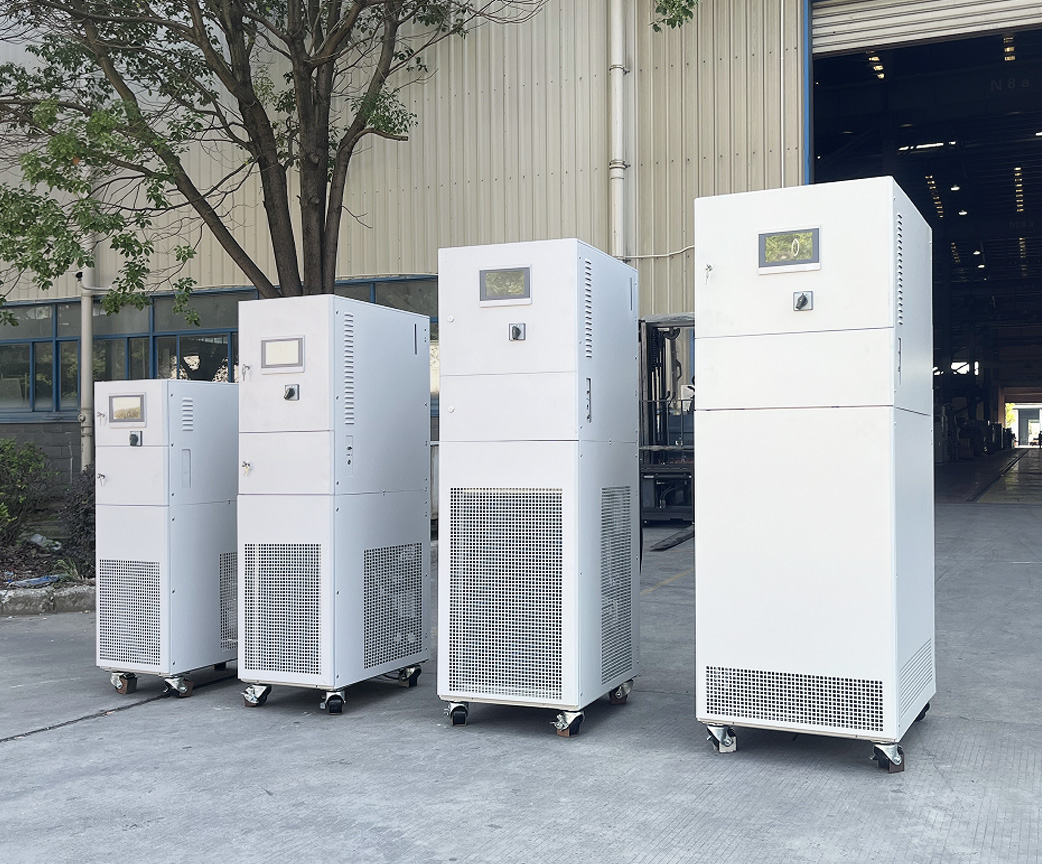 In order to achieve an economical ultra-low temperature environment for glass reactors, many customers will not choose multi-stage compressor refrigeration equipment with more than two stages, but use liquid nitrogen. The cost of liquid nitrogen is low, and this refrigeration method is welcomed by some users, both in experiments and in production. However, due to the low boiling point of liquid nitrogen (minus 195.8°C), the latent heat is small and it is easy to evaporate. There are also big problems with using liquid nitrogen refrigerators safely.
In the storage, transportation and application of liquid nitrogen, it is necessary to have storage and application equipment with good thermal insulation performance. Most of the liquid nitrogen related equipment and pipeline fittings on the market adopt double-walled vacuum container structure. The key factor affecting the performance of this vacuum container and accessories is the vacuum degree of the interlayer. Moreover, the use of liquid nitrogen puts forward higher requirements on the reactor temperature control method, heat preservation measures, material properties, equipment sealing and pressure control, and environmental safety measures. Glass reactors cooled with liquid nitrogen must still retain the advantage of being transparent and visible during the reaction. Moreover, liquid nitrogen is a health hazard: skin contact with liquid nitrogen can cause frostbite. If the nitrogen produced by vaporization under normal pressure is excessive, the partial pressure of oxygen in the air will drop, causing hypoxia and suffocation. Guanya Refrigeration’s ultra-low temperature freezer adopts the single-machine cascade refrigeration process, and the low temperature can reach minus 150 degrees; it adopts the secondary supercooling technology, and the refrigeration is rapid.
Raccomandazioni correlate
-
Descrizione dettagliata delle tubazioni delle apparecchiature del ciclo di refrigerazione e riscaldamento
2118When the refrigeration and heating cycle equipment is in operation, the user will find that whether or not the fully enclosed pipeline affects the overall performance. The LNEYA refrigeration and heating cycle equipment adopts a fully enclosed cyc...
Visualizza dettagli -

Perché esiste il dispositivo di controllo del sistema di trasferimento di calore dell'olio coke?
1854Nel dispositivo di controllo dell'olio di trasferimento di calore, l'olio di trasferimento di calore viene utilizzato per il controllo della temperatura di raffreddamento e riscaldamento. Se non è uguale a quello dell'LNEYA, l'uso del circuito completamente chiuso può influire sulla formazione di alcune cokizzazioni, che...
Visualizza dettagli -

Four Key Points of Water Cooled Chiller Installation
2129The installation of water-cooled chiller can be carried out from four aspects: first, the installation of chiller, then the installation of water pipe, water pipe cleaning and equipment insulation. Do not underestimate the installation of this par...
Visualizza dettagli -
Introduzione alla soluzione mista dei sistemi di raffreddamento a glicole (refrigeratori a glicole)
1888I refrigeratori a glicole sono sistemi di refrigerazione industriale che utilizzano un tipo di antigelo chiamato glicole, miscelato con acqua, per abbassare il punto di congelamento nell'applicazione del sistema di refrigerazione. Il glicole è una classe di composti organici che appartengono ...
Visualizza dettagli