 工業冷水機製造商 LNEYA Taiwan



Air Cooling vs Liquid Cooling System: What’s the Difference?
Efficient temperature control is essential for Refroidisseurs industriels and process cooling applications. Whether you are cooling laboratory equipment, battery testing systems, reactors, laser equipment, or manufacturing processes, the cooling method you choose can directly affect system performance, energy consumption, operating costs, and equipment reliability.
Among the various cooling technologies available today, air cooling and liquid cooling are the two most widely used solutions. Understanding the differences between these cooling systems can help you select the most suitable solution for your cooling requirements.
What Is an Air Cooling System?
An air cooling system is a heat dissipation and cooling system that uses air as the heat transfer medium to remove heat generated by industrial equipment or refrigeration units. In industrial chillers, the heat produced during the refrigeration process is released through the condenser, while fans force air over the condenser surface to carry away the heat.
This type of system has a relatively simple structure, requires no complex supporting facilities, and is convenient to install and maintain on a daily basis. However, the cooling performance of air cooling systems is significantly affected by ambient temperature. In high-temperature environments, the system needs to consume more energy to maintain the desired cooling capacity.
What Is a Liquid Cooling System?
A liquid cooling system uses a liquid as the heat transfer medium to remove heat generated by target equipment or refrigeration units. In this system, the heat produced by the equipment is first absorbed by circulating coolant, which then carries the heat to heat dissipation devices and releases it into the external environment.
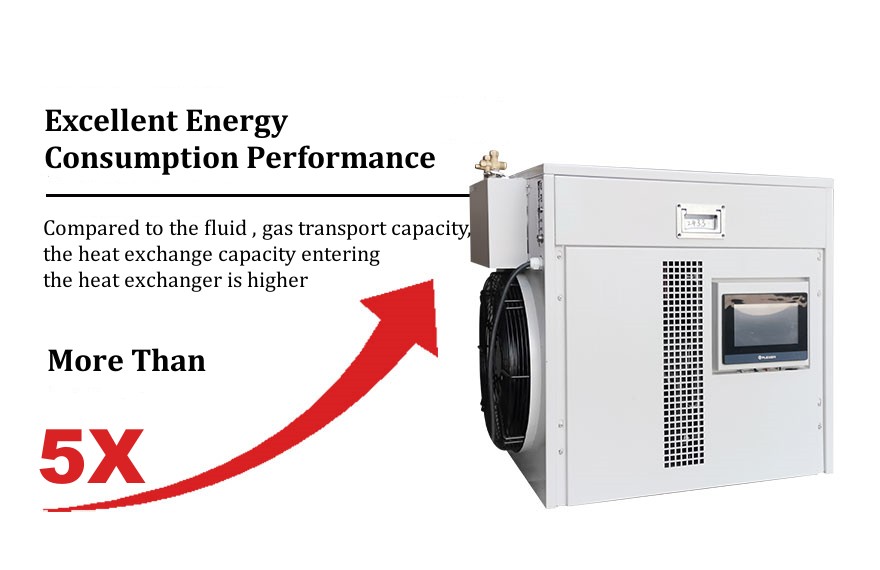
Compared to air, liquids have higher thermal conductivity and more stable heat exchange performance, enabling liquid cooling systems to achieve higher cooling efficiency and more consistent temperature control, with less impact from ambient temperature fluctuations.
However, liquid cooling systems are more complex in structure, typically requiring supporting facilities such as cooling towers and water circulation piping, and demand higher maintenance requirements than air cooling systems.
Air Cooling vs Liquid Cooling System: Key Differences
The main differences between air cooling system and liquid cooling systems are as follows:
Cooling Efficiency
Liquid cooling systems generally offer higher cooling efficiency than air cooling systems. Air cooling relies on convective heat transfer through ambient air, and its performance is significantly affected by environmental temperature.
As ambient temperatures rise, cooling efficiency can decrease noticeably. In contrast, liquid cooling provides more precise temperature control and can better meet the requirements of applications that demand high temperature stability and accuracy.
Temperature Stability
The liquid cooling system uses a more thermally conductive liquid to transfer heat. The temperature of the liquid rises more gradually, and the overall temperature fluctuation is smaller.
The temperature control accuracy can typically reach within ±0.1℃, which can meet the requirements of scenarios with extremely high temperature stability demands such as high-precision processing and semiconductor manufacturing.
In contrast, the air cooling system is more affected by air convection and temperature fluctuations in the environment. The temperature control accuracy is generally around ±1℃, and it is difficult to meet the requirements when facing high-precision cooling demands.
Installation Requirements
The installation of the air cooling system is relatively simple as no additional cooling water circulation system needs to be configured. In contrast, the liquid cooling system requires more supporting equipment, making the installation process more complex.
Operating Cost
In high-temperature environments, the air cooling system experiences a decline in heat exchange efficiency, requiring an increase in fan power to maintain the cooling capacity, resulting in a significant increase in energy consumption.
The liquid cooling system is less affected by the ambient temperature and can maintain a stable heat exchange efficiency in most operating conditions. Overall, its long-term energy consumption is lower. However, the liquid cooling system has more supporting facilities, and thus its initial investment and long-term maintenance costs are higher than those of the air cooling system.
Conclusion
Whether you choose an air cooling system or a liquid cooling system, selecting the right temperature control solution can improve cooling efficiency, enhance process stability, and reduce long-term operating costs.
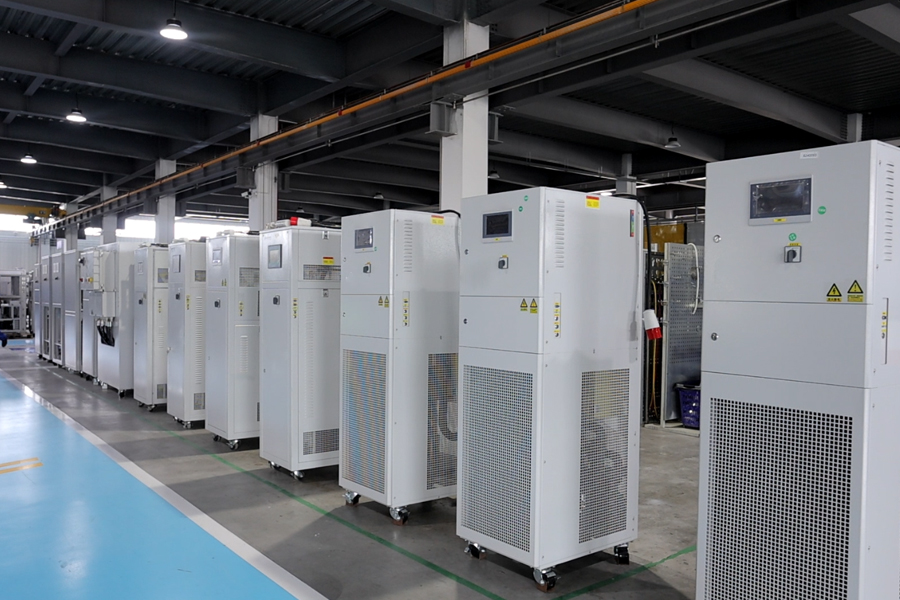
LNEYA specializes in industrial cooling and temperature control technologies. Our solutions include recirculating chillers for continuous process cooling, Refroidisseurs de batteries for advanced battery thermal management, temperature forcing systems for rapid thermal cycling and component testing, as well as other customized cooling and heating systems designed for precise temperature control.
Please feel free to nous contacter to help you select a more suitable industrial temperature control system.
Obtenez un devis détaillé gratuitement !
Foire aux questions
CONTACTEZ-NOUS
TEL:
EMAIL:
WeChat et WhatsApp:

Wechat QR