 工業冷水機製造商 LNEYA Taiwan



What is a Microchannel Heat Exchanger in a Chiller
The microchannel heat exchanger is a modern alternative to the old tube and fin coil. It uses flat, multi-pass channels etched into aluminum plates. That design changes how refrigerant and air meet. It also changes how technicians plan installation and maintenance.
This article explains what a microchannel heat exchanger is, how it functions inside a refroidisseur, and why engineers choose it.
What is a microchannel heat exchanger?
A microchannel heat exchanger is a compact heat transfer device built from thin aluminum plates. Each plate contains many small passages. Those passages direct réfrigérant in parallel paths. On the outside, fins increase the air contact area. The entire pack is brazed into a single assembly.
Manufacturers often call the assembly a microchannel coil or microchannel condenser when used on air cooled systems.
Construction and materials of a microchannel heat exchanger
The basic parts are flat tubes or channels, fins, and manifolds. Everything is aluminum. That keeps weight down and avoids mixed metal corrosion problems found in copper aluminum assemblies. The brazed joints create a leak tight structure.
How a microchannel heat exchanger differs from a tube and fin coil?
Traditional coils use circular copper tubes and separate fins. Microchannel designs integrate the flow paths into the flat plate. That reduces air side resistance and increases heat transfer per unit face area. The coil face looks flatter and denser than older coils. It also tends to have a thinner overall depth.
How does a microchannel heat exchanger work in a chiller?
In refroidisseurs à air, the microchannel heat exchanger acts as the condenseur. High pressure vapor from the compressor flows into a manifold. The manifold distributes refrigerant into many tiny channels. Air from fans flows across the fins and removes heat. The refrigerant condenses inside the narrow passages and leaves as a liquid toward the receiver or expansion device.
What are the benefits of MCHE?
Higher heat exchange efficiency
Small channels mean higher refrigerant velocity in each passage. Higher velocity helps convective heat transfer. It also forces more uniform temperature across the coil face. On the air side, thinner plates and closer fin spacing increase the heat flux. The net effect is better thermal performance for the same frontal area.
Lower refrigerant charge
Because the internal volume of microchannel passages is small, the total refrigerant charge in the condenser drops substantially. Typical reductions can be in the tens of percent range, and in some designs they reach around 30 to 40 percent compared with older coils. That reduces both cost and environmental risk.
Compact and space saving structure
Microchannel coils achieve the same heat duty in a smaller footprint. For rooftop units or tight plant rooms, that makes a big difference. You may be able to shorten ducting, reduce frame size, or fit more modules in the same area. People often use microchannel condensers to reduce cabinet depth and overall installed volume.
Lightweight and easier handling
Aluminum construction reduces weight significantly. That simplifies lifting and lowers support structure requirements. For mobile racks or units that ship as modules, lighter coils reduce freight cost and the complexity of skids.
Discuss your temperature control needs with LNEYA
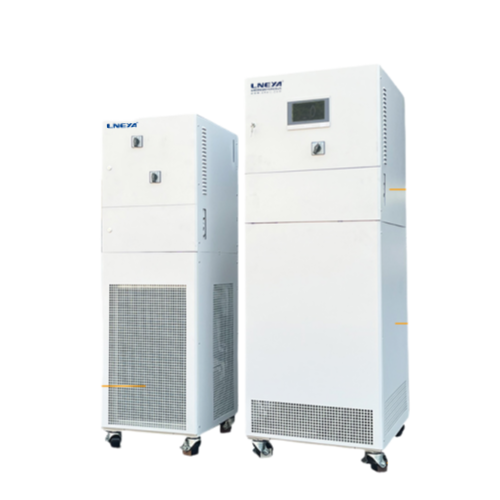
To ensure cooling efficiency while reducing equipment size and weight, microchannel heat exchangers are commonly used in our mini chillers and portable chillers. If you have these needs, please discuss them with our chiller experts.
Articles récents
- Clean Room Temperature Control
- Data Center Cooling System
- Power Electronics Cooling
- Feedback Control System
- Electronic Expansion Valve
- R32 vs R410A
- Fabrication de semi-conducteurs
- Circulateur réfrigéré
Catalogue
- juillet 2026
- juin 2026
- décembre 2025
- novembre 2025
- octobre 2025
- septembre 2025
- août 2025
- juillet 2025
- juin 2025
- mai 2025
- mars 2025
- février 2025
- janvier 2025
- décembre 2024
- novembre 2024
- octobre 2024
- septembre 2024
- août 2024
- juillet 2024
- juin 2024
- mai 2024
- avril 2024
- mars 2024
- février 2024
- septembre 2023
- juillet 2023
- juin 2023
- mai 2023
Étiquette
refroidisseur à air refroidisseur chiller cooling capacity Refroidisseur-chauffeur Installation d'un refroidisseur Chiller Maintenance chiller refrigerant refroidisseurs Dépannage du refroidisseur refroidisseur d'eau système de refroidissement custom chiller Réacteur en verre double couche système de contrôle dynamique de la température refroidisseur écoénergétique refroidisseur antidéflagrant refroidisseur au glycol circulateur de chauffage Chiller de récupération de chaleur refroidisseur industriel Refroidisseurs industriels refroidissement industriel congélateur industriel réacteur à double enveloppe refroidisseur de laboratoire liquid cooling Refroidisseur de refroidissement liquide nouvelles refroidisseur d'huile refroidisseur pharmaceutique refroidisseur de processus refroidissement de processus process cooling system refroidisseur de réacteur refroidissement du réacteur chauffage du réacteur refroidissement système de réacteur refroidisseur à vis Refroidisseur pour semi-conducteurs refroidisseur pour tests de semi-conducteurs contrôle de la température refroidisseur pour essais de véhicules refroidisseur d'eau refroidisseur à eau
Contactez-nous
Chillers associés
CONTACTEZ-NOUS
TEL:
EMAIL:
WeChat et WhatsApp:

Wechat QR

Vous avez une question ou besoin d’un devis ? Remplissez le formulaire ci-dessous et notre équipe vous répondra sous 24 heures.