 工業冷水機製造商 LNEYA Taiwan



À quoi dois-je faire attention lorsque j'ajoute du réfrigérant à un refroidisseur à eau ?
In our life, we believe that everyone is
very familiar with refrigeration. In the central air conditioning and
industrial production process cooling industry, small water-cooled chillers is
more common. This unit is composed of a compressor in the fuselage, a
horizontal shell and tube condenser, an evaporator, a thermal expansion valve,
and some related parts. Under the cooperation of these auxiliary parts, the
overall small water cooled chiller is compact in structure, convenient in
operation and control, and is popular among the public in the market.

For refrigeration systems that do not have
a high pressure reservoir and a low pressure vapor-liquid separator, the
control of refrigerant charge is particularly important. Because the
refrigeration system is a condenser and also acts as a high-pressure reservoir,
the refrigerant is stored in the condenser, and the condenser is cooled. The
heat dissipation area is reduced and the condensing pressure is increased,
resulting in a decrease in cooling capacity.
For the control of the refrigerant charge
of such small water-cooled chillers, the following methods are followed during
the filling process:
First, touch the temperature of the
condenser casing.
The upper outlet of the condenser outlet is
heated above the outlet, and the outlet below the outlet is cool. (There is a
description of the high temperature exhaust of the compressor in the inside.
The cooling indicates that the small water-cooled chillers is a liquid space.)
Second, look at the inspiratory pressure.
Corresponding to the temperature of the
refrigerant water in the evaporator. (That is, corresponding to the evaporation
temperature.)
Third, look at the compressor return pipe
temperature.
The high-temperature unit return pipe
should be cooled and dew, but it can be dew condensation to the compressor
return valve; the low-temperature unit return pipe should be frosted, but the
frost can be connected to the compressor return valve. If condensation or frost
builds up on the compressor casing, liquid refrigerant will enter the
crankcase, causing the compressor to run back and cause liquid
problem.
The above is a partial analysis of our
LNEYA technicians for water-cooled chillers. Regarding the specific use of our
water-cooled chillers, you can contact us sales@lneya.com for more detailed
instructions.
Recommandations connexes
-
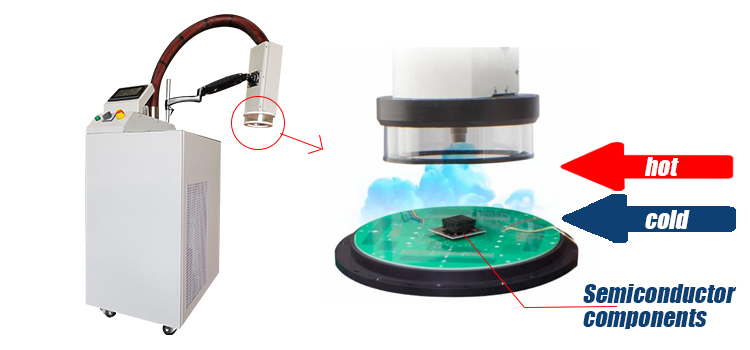
LED LCD display thermal test system operation process
1884The integrated semiconductor industry has developed rapidly in the past two years, which has driven other industries around it. The chip thermal test system is one of the products. In order to avoid machine failures in the LED liquid crystal displ...
Voir les détails -

Quelles sont les industries qui utilisent les équipements de test des dispositifs à semi-conducteur ?
2092Semiconductor device test equipment is used more in the semiconductor industry. So, how much do you know about the applicable semiconductor conductors? The properties of this substance are still recommended to the user. In general, substances can ...
Voir les détails -

How to ground the electric vehicle battery test driver?
2000The electric vehicle battery test is in the running state, and it is necessary to understand the operation of the accessories, and the drive and other accessories are in operation. If the electric vehicle battery test is not isolated between the A...
Voir les détails -
The Refrigeration Principle of Heating Cooling Circulator
2015Heating cooling circulator is the use of limited refrigerant in the closed refrigeration system, repeatedly refrigerant compression, condensation, expansion, evaporation, constantly in the evaporator heat absorption vaporization, cooling. The heat...
Voir les détails