 工業冷水機製造商 LNEYA Taiwan



Il existe généralement trois façons de contrôler la température des réacteurs de laboratoire
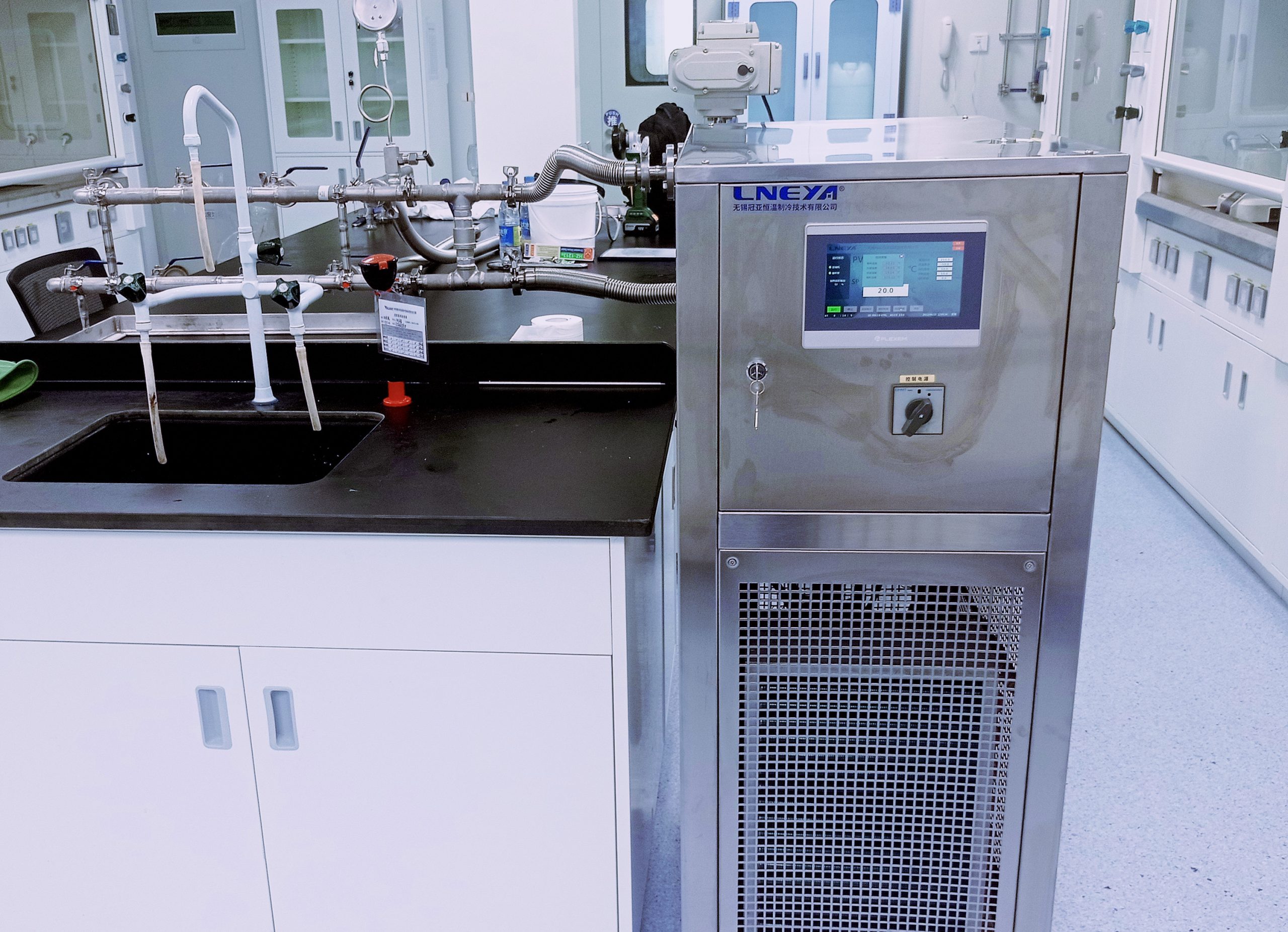
1. Manual control: Manually operate the knob on the front of the reactor controller.
2. Control by PC: The PC and the controller are connected by a network cable, and the operation is carried out on the PC.
3. Controlled by thermostat: Silicone oil is heated through the thermostat, and the thermostat naturally has a temperature control function. Although the thermostat heating limit (usually 250°C) is not as high as that of electric heating (can be as high as 400-500°C), the thermostat rises and falls smoothly, and the low temperature can reach -60/-80°C.
Our LNEYA laboratory reactor temperature control system belongs to the third category. However, the temperature control range is from -120 degrees to 350 degrees. It adopts a fully enclosed pipeline design and a high-efficiency plate heat exchanger, which reduces the demand for heat transfer oil, improves the heat utilization rate of the system, and realizes rapid temperature rise and fall. Continuous temperature control can be achieved in the temperature range of minus 90 degrees to 195 degrees and minus 70 degrees to 220 degrees without pressure.
Jacketed glass reactors are popular in current chemical experiments. The supporting temperature control equipment has also become a matter of widespread concern in the industry. It is known that the cooling and heating temperature in the reaction process has an absolute influence on the reaction process and results. The analysis of the temperature control equipment’s ability to increase and decrease the temperature of the material has become the basic basis for choosing chiller. Then the cooling and heating capacity is not only estimated by imagination and experience, but requires scientific analysis and calculation methods, and needs to calculate the required heating power and cooling power according to the heating rate and cooling rate.
When our technicians communicate with customers, they will first understand the requirements of engineering parameters, such as high and low temperature, how long is the temperature control time, etc., so as to calculate the cooling power and heating power of the chiller required, and determine the available chiller. model, to give customers the most complete temperature control solution. If you also have this need, you can contact us.
Recommandations connexes
-

API China [A1A20-2] welcomes new and old customers!
310API China, as a long-standing and large-scale exhibition in China's industrial field, has promoted and witnessed the development and growth of the pharmaceutical industry, and has also been accompanied by generations of Chinese pharmaceutical peop...
Voir les détails -
If the Industrial Chiller Fails to Start, It Can Be Excluded According to the Following Experience
18901. Check the main circuit first. Such as whether there is electricity in the power supply, whether the voltage is normal, whether the fuse has been burned due to starting overload, whether the air switch trips, whether the switch contacts are good...
Voir les détails -

Where are the applications of the CO2 supercritical extraction cryogenic refrigeration unit?
1944With the continuous development of co2 supercritical extraction technology, co2 supercritical extraction cryogenic refrigeration devices have attracted the attention of many industries due to their own characteristics, and have been widely used in...
Voir les détails -
Steaming system temperature control safety requirements
2149The steaming system temperature control is one of the low temperature refrigerators designed and produced by Wuxi Guanya LNEYA. The temperature range is from -5 °C to -150 °C. The secondary subcooling technology is adopted, the refrigeration is ra...
Voir les détails