 工業冷水機製造商 LNEYA Taiwan



Temperature control instructions for stainless steel reactors and glass reactors
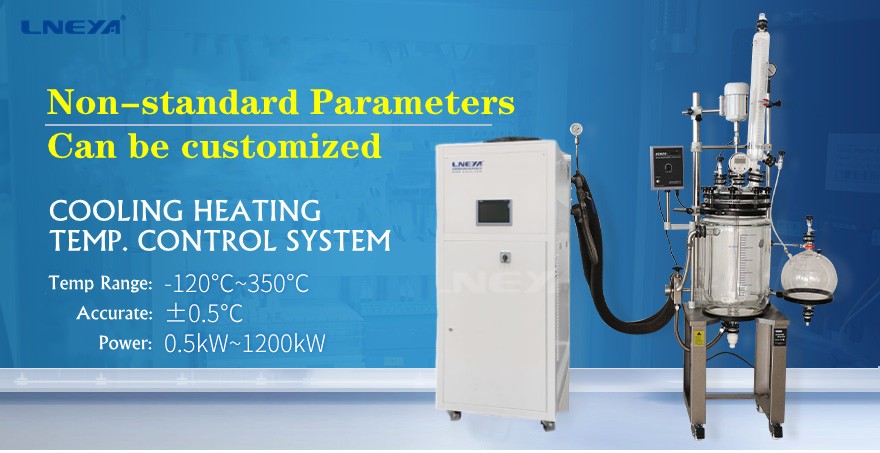
Reactor is a kind of reaction equipment in industrial production. It generally needs to be refrigerated or heated. Whether the temperature is suitable or not directly affects its reaction effect. Therefore, if conditions permit, it is generally equipped with a reactor temperature control device. The temperature control device of the reaction kettle uses the conversion of heat conduction oil to heat the material to be heated. Inferior heat conduction oil has a short service life and is prone to scaling. Impurities will decompose under high temperature conditions, and the temperature cannot rise. There is water vapor It will cause more fuel injection. Generally, it is advisable to control the temperature of the reaction solution within 30-300°C for the electric heating reactor. Furthermore, the double-layer glass reactor can choose the corresponding low-temperature refrigeration cycle system for refrigeration, and the low temperature can reach -120°C. Heating can choose water vapor, hot water, heat transfer oil and other heat carriers, and the high temperature can reach 300 °C. Another example is that the temperature of the enamel reaction kettle is 200°C, so the temperature of the material in the kettle is not allowed to exceed this temperature.
Most temperature control applications involve stainless steel reactors, which are more durable, and glass reactors, which allow the user to observe the reaction process inside the reactor. There are many precautions to consider for the safety of glass reactors. Typically, a reactor has an internal cavity in which materials requiring temperature control are stored. The inner cavity is surrounded by a jacket that can be connected to heat-conducting oil, and the temperature control system is connected with the jacket of the reactor. In order to control the temperature of the reactor, the thermal oil is heated and cooled in the temperature control equipment. The temperature control system of the reactor continuously pumps the heat transfer oil into the jacket of the reactor through the circulation pump. Sudden temperature changes inside the reactor will be compensated by rapid heating and cooling of the temperature control equipment to achieve dynamic equilibrium.
Temperature control uses water circulation or oil circulation for temperature control, and the connecting equipment must have flow channels and interlayers. In industry, wherever temperature is required, temperature control is required. Our LNEYA cooling and heating temperature control system can basically be used for temperature control in the above industrial processes. The temperature is from -120~350℃. Plate heat exchangers and pipeline heaters are used to increase the temperature control rate, high-efficiency production stability and repeatable results, providing dynamic constant temperature control of cold source and heat source, fully enclosed system, reducing the demand for heat transfer fluid and increasing the heat of the system utilization rate.
Verwandte Empfehlungen
-

The ethylene glycol chiller solution is too cold and too hot
2115When the ethylene glycol chiller solution is overheated and overcooled during operation, if you don't understand these conditions well, you will not be able to operate the equipment well. The supercooling phenomenon of the solution of the glycol...
Details anzeigen -
Wie lässt sich das Problem der schlechten Kühlleistung des Wärmeträgeröl-Kreislaufsystems lösen?
2067Einige wärmeleitende Ölzirkulationssysteme sind nach 3 Monaten des Gebrauchs nicht mehr so gut wie zuvor. Zu diesem Zeitpunkt wird empfohlen, den professionellen Kundendienst zu kontaktieren, um die Stromversorgung des Benutzers zu überprüfen und ob das Gerät normgerecht ist...
Details anzeigen -

Install a refrigeration unit for the circulating cooling water of the quenching tank
2094The quenching tank is a container filled with quenching medium. When the workpiece is immersed in the tank for cooling, it must be able to ensure that the workpiece is uniformly quenched at a reasonable cooling rate. It is a container that provide...
Details anzeigen -
Sie sollten etwas über Tiefkühltruhen mit extrem niedriger Temperatur wissen
1592Der Ultratiefkühlschrank ist ein unverzichtbares kryogenes Lagerungsgerät im Bereich der Biowissenschaften und Biopharmazeutika. Er kann für die Lagerung von Zellen, Geweben, Testproben, Impfstoffen, aktiven Enzymen, Stämmen, Plasmiden, Viren und Bakterien verwendet werden...
Details anzeigen