 工業冷水機製造商 LNEYA Taiwan



Install a refrigeration unit for the circulating cooling water of the quenching tank
The quenching tank is a container filled with quenching medium. When the workpiece is immersed in the tank for cooling, it must be able to ensure that the workpiece is uniformly quenched at a reasonable cooling rate. It is a container that provides sufficient cooling capacity for the quenching of the workpiece to meet the technical requirements .
The quenching tank structure is relatively simple, mainly composed of tank body, medium input or discharge pipe, overflow tank, etc., and some are additionally equipped with heaters, coolers, stirrers and smoke exhaust fire prevention devices. The temperature of the quenching medium is one of the important factors affecting the quenching effect of the workpiece. Therefore, strictly controlling the temperature of the medium in the quenching tank is a measure to ensure the quality of heat treatment.
There are mainly three types of quenching tanks, oil tanks and bath tanks on the market. Here we mainly talk about the quenching tank. According to the cooling method, the water-cooling type has higher cooling efficiency, but because the temperature of the cooling water needs to be controlled, a sufficiently large cooling pool must be established. At the same time, the circulating cooling of the cooling water also requires the addition of a chiller unit to the quenching tank.
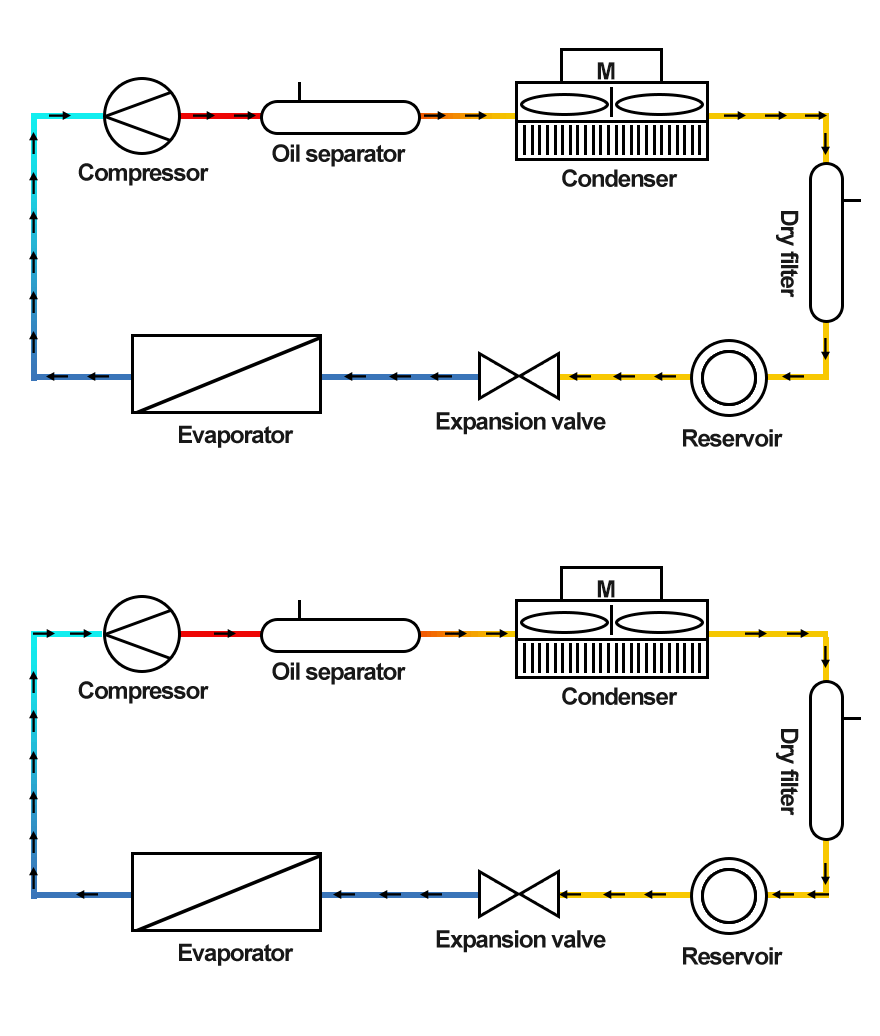
For large production batches, continuous production or large quenching tanks, the heated quenching medium is discharged into the cooling system for circulating cooling. Circulating replacement cooling water consumes a lot of resources, so additional refrigeration units are good news for manufacturers. The refrigeration temperature range of LNEYA cycle refrigeration unit is -150°C to -5°C, which can meet the needs of different refrigeration temperatures. The refrigeration speed is fast and can be frozen to -120°C within 3 minutes after stable operation. LNEYA provides equipment on-site installation and system testing. Users only need to complete the installation of refrigerant and cooling water.
관련 추천
-
고온 환경 챔버 판매의 설계 및 테스트 기술
26441. 온도 선택 (1) 해당 지역의 기후대, 제품이 난방 장치 근처의 태양 복사 환경에 노출되는지 여부, 주변 공기, 태양 복사 및 난방 장치에서 제품으로의 열 전달 방식...
세부 정보 보기 -

다단계 냉동 시스템 원심 컴프레서 수리 지침
2548캐스케이드 냉동 시스템의 원심 압축기를 분해 한 후 각 저널 (임펠러, 베어링, 커플 링 등과 협력)의 치수를 외경 마이크로 미터로 측정하여 진원도를 계산합니다 ...
세부 정보 보기 -
What is the temperature of the cryogenic cooling circulator?
2019The LNEYA cryogenic cooling circulator has a cooling temperature range from -125 degrees to -20 degrees. It adopts a computer cascade temperature controller and a PT100 temperature sensor, and the temperature control accuracy can reach ±0.1 degree...
세부 정보 보기 -

The Role of Chemical Refrigeration Temperature Control Unit
1988In pharmaceutical and chemical plants, the raw materials inside the reactors involved in industrial production require rapid cooling and cooling. In order to achieve this goal, the reactor undergoes direct refrigeration and cooling, thereby indi...
세부 정보 보기