 工業冷水機製造商 LNEYA Taiwan



Power Electronics Cooling: Key Cooling Technologies
Power electronic devices generate heat whenever they convert or control electrical energy. If this heat is not removed efficiently, component temperatures rise quickly, reducing efficiency, accelerating aging, and increasing the risk of unexpected system failures. Effective cooling is therefore essential for maintaining reliable operation in modern industrial equipment.
What Is Power Electronics Cooling
Power electronics cooling is the process of removing heat generated by power semiconductor devices during operation. Its primary purpose is to keep critical components within a safe operating temperature range while maintaining stable electrical performance and long-term system reliability.
A complete power electronics cooling system includes more than a cooling device. It combines heat transfer, coolant circulation, heat exchange, temperature monitoring, and intelligent control to continuously balance heat generation and heat removal. The result is improved equipment efficiency, better operating stability, and longer service life under demanding industrial conditions.
Key Cooling Technologies for Power Electronics
Air Cooling
Air cooling is one of the most widely used cooling methods for power electronics. Heat generated by electronic components is transferred to heat sinks, where cooling fans remove thermal energy through forced airflow.
Because of its simple structure and relatively low installation cost, air cooling is commonly used in equipment with moderate power levels and sufficient ventilation space. It requires fewer supporting components and is generally easier to maintain than liquid-based cooling systems.
However, as power density continues to increase, the cooling capacity of air becomes a limiting factor. High ambient temperatures, dust accumulation, and restricted airflow can all reduce cooling performance, making air cooling less suitable for high-power industrial applications.
Liquid Cooling
Liquid cooling removes heat by circulating a coolant through cold plates, heat exchangers, or cooling channels located close to the heat source. Compared with air, liquids have much higher thermal conductivity and heat capacity, allowing them to absorb and transport larger amounts of thermal energy.
This higher heat transfer efficiency allows liquid cooling systems to maintain lower component temperatures while supporting higher power densities. As a result, liquid cooling has become the preferred solution for many industrial applications, including electric vehicle power electronics, battery energy storage systems, semiconductor manufacturing equipment, and high-power industrial drives.
Modern liquid cooling systems are often integrated with промышленные чиллеры and precision temperature control systems, providing stable coolant temperatures throughout continuously changing operating conditions.
Cold Plate Cooling
Cold plate cooling is a specialized form of liquid cooling in which coolant flows through internal channels inside a metal cooling plate. Power semiconductor devices are mounted directly onto the plate, allowing heat to transfer efficiently from the device into the circulating coolant.
Because the cooling surface is positioned immediately beneath the heat source, thermal resistance is significantly reduced. This allows cold plate cooling to provide highly uniform temperatures while supporting compact equipment designs with high power density.
Direct Refrigerant Cooling
Direct refrigerant cooling uses refrigerant as the cooling medium instead of a secondary coolant. The refrigerant absorbs heat directly from the heat source as it evaporates, allowing thermal energy to be removed efficiently with fewer heat transfer stages.
Because heat is transferred directly to the refrigerant, this technology can achieve lower operating temperatures and faster cooling response than many conventional liquid cooling systems. It is particularly suitable for applications requiring high cooling capacity within limited installation space.
However, direct refrigerant cooling requires a more complex refrigeration system and higher sealing reliability. Proper refrigerant management, pressure control, and system integration are essential to maintain stable long-term operation.
Immersion Cooling
Immersion cooling removes heat by placing power electronic components directly into a specially engineered dielectric cooling fluid. Since the coolant is non-conductive, it can safely come into contact with electronic components and continuously absorb heat during operation.
Compared with conventional cooling methods, immersion cooling provides excellent temperature uniformity and extremely high heat removal capability. It also reduces the need for large heat sinks or high-speed cooling fans, making it attractive for equipment with very high power density.
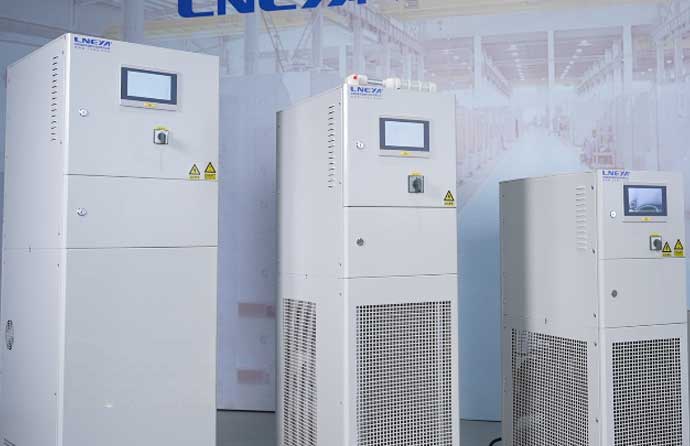
Comparing Different Power Electronics Cooling Technologies
Each power electronics cooling technology has its own advantages depending on heat load, system design, and operating requirements. There is no single cooling method that can meet every application.
Air cooling is usually suitable for low and medium power applications where heat generation is limited and sufficient airflow is available. It provides a simple and cost-effective cooling solution, but its heat removal capability becomes limited when power density increases.
Liquid cooling provides higher heat transfer efficiency because liquid coolant can carry significantly more thermal energy than air. It is commonly selected for high-power applications that require stable temperature control and continuous operation.
Cold plate cooling offers a more direct thermal path by placing cooling channels close to power semiconductor devices. This reduces thermal resistance and improves temperature uniformity, making it suitable for compact systems with high heat flux requirements.
Direct refrigerant cooling uses the evaporation of refrigerant to directly absorb heat, providing rapid response and high cooling capacity. However, it requires more complex refrigeration system design and precise control.
Immersion cooling provides excellent heat transfer performance by directly surrounding components with dielectric cooling fluid. It is mainly considered for extremely high power density applications where traditional cooling methods may not provide sufficient performance.
How to Choose the Right Cooling Technology
Consider Heat Load and Power Density
The first step is evaluating how much heat the power electronic components generate during operation. Higher power density usually requires more efficient cooling methods, such as liquid cooling or cold plate cooling.
Consider Installation Conditions
Available space, environmental conditions, and system integration requirements also affect cooling technology selection. Compact equipment may benefit from cold plate cooling, while larger industrial systems may use centralized liquid cooling solutions.
Consider Long-Term Reliability
A cooling system should not only meet current thermal requirements but also support long-term operation. Factors such as maintenance requirements, coolant management, and energy efficiency should be evaluated before selecting a final solution.
Selecting the right power electronics cooling technology helps you maintain stable operating temperatures, improve equipment efficiency, and extend the service life of critical components.
Заключение
Whether you are developing electric vehicle power electronics, battery energy storage systems, semiconductor equipment, or industrial power systems, selecting the right cooling technology is essential for achieving reliable and efficient operation. Contact ЛНЕЙЯ today to discuss your application requirements and find a suitable thermal management solution.
Нужна индивидуальная система охлаждения для вашего процесса?
ЧАСТО ЗАДАВАЕМЫЕ ВОПРОСЫ
СВЯЗАТЬСЯ С НАМИ
TEL:
EMAIL:
WeChat и WhatsApp:.

Wechat QR