 工業冷水機製造商 LNEYA Taiwan



How to Choose the Right Laser Chiller for a Laser Cutting Machine
A chiller dedicated to laser cutting equipment provides a stable cooling source, keeping the machine components at the optimal operating temperature and preventing frequent shutdowns or damage caused by overheating. This article explains how to select the most suitable chiller for your laser cutting machine based on your actual working conditions.
1.Identify Your Laser Type
You must first confirm the laser type and rated power, because CO2 and fiber lasers have very different cooling temperature stability, flow rate, and heat load requirements.
CO2 Laser
CO2 laser tubes are very sensitive to temperature fluctuations. Most manufacturers recommend keeping the cooling water between 18℃ and 25℃, with a temperature control accuracy of ±0.3℃. If you use a standard water tank or equipment with ±1℃ temperature fluctuation, you may experience unstable laser power, rough cut edges, and reduced laser tube lifespan.
Many people think a CO2 laser chiller only needs to lower the temperature, which is a misconception. Temperature stability has a greater impact on beam quality than the absolute temperature. Otherwise, when cutting acrylic continuously, you will notice visible color changes along the cut lines.
Fiber Laser
The heat in a fiber laser is concentrated in the laser source and fiber modules. The power density is high, and heat is released quickly. At an ambient temperature of 35℃, if a 1000W fiber laser runs continuously for 8 hours and the chilled water flow is insufficient, the laser source temperature will rise, resulting in noticeable power decay and longer penetration times when cutting thick materials. Therefore, when selecting a chiller for a fiber laser, it is important to pay attention to its cooling capacity.
2.Calculate Required Cooling Capacity
When calculating the required 냉각 용량 for a chiller, you should first estimate the actual heat load generated by the laser, and then add 20% to 50% extra capacity to prevent overload, reduced performance in summer, and instability during continuous operation. The required cooling capacity should be calculated separately based on the different efficiencies of CO2 and fiber lasers.
CO2 Laser
The electro-optical conversion efficiency of a CO2 laser is usually only 10% to 20%. Assuming 15%, a 100W output requires an input power of approximately 100÷0.15≈667W. Of this, about 100W becomes light, and about 567W becomes heat, which must be carried away by water cooling.
In practice, the cooling heat load of a CO2 laser is usually 6 to 8 times its output power. For a 100W CO2 laser cutter, the recommended chiller capacity is generally 600 to 800W. Considering redundancy, an 800W chiller is typically selected.
Fiber Laser
The electro-optical conversion efficiency of a fiber laser is usually 30% to 40%. Assuming 35%, a 1000W fiber laser requires an input power of approximately 2850W. Of this, 1000W becomes light, and about 1850W becomes heat. However, not all the heat is carried away by water; some is dissipated through air-cooling structures.
The heat that actually needs to be removed by water is generally close to the laser output power. According to industry experience, fiber cooling load ≈ laser output × 1.0–1.3. For example, the basic cooling requirement for a 1000W fiber laser is generally between 1000W and 1200W. Adding 20% to 50% redundancy, a chiller with 1500W capacity is more suitable.
3.Check Flow Rate and Pressure Requirements
Even if cooling capacity is sufficient, insufficient flow rate or incorrect pressure will reduce heat exchange efficiency and cause laser overheating.
The heat generated by a laser cutting machine is carried away by circulating water. If the chilled water flow is insufficient, heat exchange efficiency decreases, internal laser heat accumulates, and local overheating can occur. A 1000W fiber laser typically requires 20 to 30 L/min of flow, while a 3000W unit may need 40 to 60 L/min. In addition, many fiber laser chillers use dual water circuits—one for the laser source and one for the cutting head. When selecting a chiller, you must confirm whether a dual-channel laser chiller is needed.
It is also important to understand the concept of delta T, which is the temperature difference between the inlet and outlet water. Under normal conditions, delta T is generally 3℃ to 5℃. If ΔT is too high, the flow is insufficient. If ΔT is too low, the cooling capacity may be excessive or the load is insufficient.
Pressure selection is also critical. Excessive water pressure can damage the laser cooling channels and may trigger flow alarms. Insufficient pressure can cause uneven water distribution and reduced cooling efficiency. You should always check the laser manual for the recommended flow rate, pressure range, and inlet and outlet sizes.
4.Consider Working Environment
Ambient temperature, installation space, and workload directly affect chiller performance and determine whether you need air cooled, water cooled, or dual channel systems.
When the ambient temperature in the workshop exceeds 40℃, the condensing efficiency of an air-cooled laser chiller drops significantly. You may notice the compressor starting frequently, high-temperature alarms being triggered, and reduced cooling capacity. In this case, a 수냉식 냉각기 with a cooling tower system is recommended.
If the installation space in the workshop is limited, an integrated laser chiller is recommended. It uses a modular design, occupies less floor space, and has well-designed air inlets and outlets for side-by-side placement. However, sufficient intake and exhaust space must be ensured to prevent hot air recirculation, which would reduce cooling efficiency.
If you have two fiber lasers, you can consider a dual-channel laser chiller. Each channel can independently control temperature, pressure, and flow without interfering with the other. Otherwise, if one laser shuts down, the other may experience temperature fluctuations.

5.Control Accuracy and Alarm System
Temperature stability and complete alarm protection determine laser lifespan, cutting precision, and operational safety.
The temperature control accuracy of a CO2 laser chiller is recommended at ±0.3℃, while a high-precision fiber laser chiller should maintain temperature fluctuations within ±0.1℃. Excessive temperature variation can negatively affect product quality.
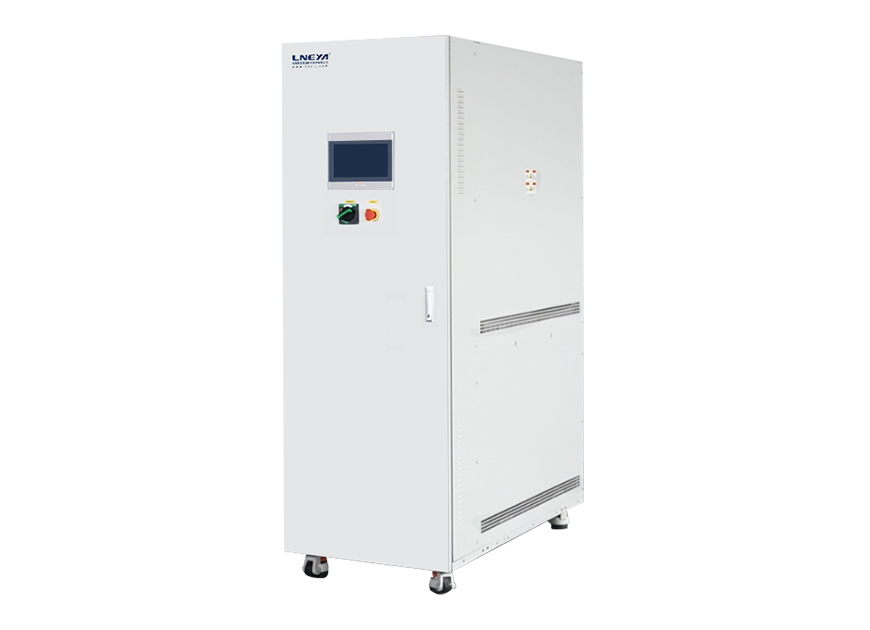
In addition, a proper industrial laser chiller must include complete safety protections and alarm systems, such as high-temperature alarms, flow alarms, compressor load alarms, and phase protection.
If you want to achieve a high level of automation for your workshop and production lines, you should choose a chiller that supports IoT, allowing for remote monitoring and centralized management.
자주 묻는 질문
LNEYA:Reliable Laser Chiller Manufacturer
Are you looking for a 레이저 냉각기? LNEYA is a professional laser chiller manufacturer with over 15 years of experience. We provide a full range of standard and custom laser cooling solutions.You can get one-stop service from consultation to after-sales support at LNEYA.