 工業冷水機製造商 LNEYA Taiwan



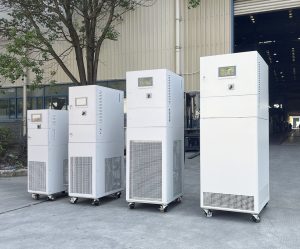
Which processes of ultrafine material enterprises require cooling water chillers?
Ultrafine material enterprises often require precise temperature control during the production process to ensure the quality of the product and the stability of the production process. Water chillers play a key role in multiple processes of ultrafine material enterprises.
The following are the main applications of water chillers in ultrafine material enterprises:
1.Raw material pretreatment:
- Drying process: During the drying process of ultrafine materials, the temperature of the drying equipment needs to be precisely controlled to avoid over-drying of the raw materials or excessive moisture content.
- Mixing process: When mixing raw materials, the temperature of the mixing equipment may need to be controlled to ensure that the raw materials are mixed evenly.
2.Preparation process:
- Grinding process: During the grinding process, due to the heat generated by high-speed rotation and friction, a water chiller is required to control the temperature of the grinding equipment to ensure the quality of the material.
- Spray drying: During the spray drying process, the temperature in the drying tower needs to be precisely controlled to ensure the particle size distribution and dryness of the powder.
- Solvent evaporation: When using the solvent evaporation method to prepare ultrafine materials, the temperature of the evaporator needs to be controlled to ensure complete evaporation of the solvent without destroying the material structure.
3. Synthesis process:
•Chemical reaction: The synthesis of many ultrafine materials requires precise temperature control to ensure that the reaction proceeds as expected, such as in processes such as chemical vapor deposition (CVD) or hydrothermal synthesis.
•Polymerization reaction: When synthesizing polymer-based ultrafine materials, the temperature of the reactor needs to be controlled to ensure the molecular weight distribution and degree of polymerization.
4. Post-treatment process:
•Washing process: When washing ultrafine materials to remove residual solvents or impurities, the temperature of the washing equipment needs to be controlled.
•Heat treatment: During the heat treatment process, the temperature of the heating furnace needs to be precisely controlled to improve the crystallinity or structure of the material.
5. Performance test:
•Thermal performance test: When testing the thermal properties of ultrafine materials, a cooling water chiller is required to control the temperature of the test environment to ensure the accuracy of the test results.
•Thermal cycle test: When simulating the performance of the material under different temperature conditions, the temperature change needs to be precisely controlled.
6. Packaging process:
•Encapsulation material curing: When curing the encapsulation material, the temperature of the curing furnace needs to be controlled to ensure the performance of the material.
Temperature control range:
- Low temperature range:
- Low temperature cooling: For processes that require low temperature cooling, such as certain chemical reactions or material synthesis processes, it may be necessary to control the temperature close to or below 0°C.
- Ultra-low temperature cooling: In some special cases, lower temperatures may be required, such as -20°C to -80°C, for specific material processing or research.
2. Medium temperature range:
- Normal temperature cooling: Many ultrafine material processing processes require the temperature to be controlled near room temperature, such as 20°C to 25°C.
- Mild heating: In some cases, the temperature needs to be controlled at a level slightly above room temperature, such as 30°C to 40°C.
3. High temperature range:
- High temperature cooling: For processes that require higher temperatures, such as certain heat treatment processes, it may be necessary to control the temperature at 50°C to 100°C.
- High temperature heating: In some synthesis processes, higher temperatures may be required, such as 100°C to 200°C or higher.
In summary, water cooling units play an important role in many processes of ultra-fine material enterprises, ensuring the temperature control accuracy in the production process and improving product quality and production efficiency. Through precise temperature control, the physical and chemical properties of ultra-fine materials can be well controlled, thus meeting the performance requirements of the final product.
Industrial Water ChillersChilled Water Systems
loading…
已经是到最后一篇内容了!
loading…
已经是到最后一篇内容了!
Related recommendations
-
Temperature control and chillers in oxidation diffusion process
1680The oxidation diffusion process is a key step in semiconductor manufacturing. It is mainly used to form precise oxide layers and doping, and has extremely strict requirements for temperature control. In this process, the chiller, as an important p...
View details -
Semiconductor Temperature Forcing System Thermal Flow Hood for DUT Testing
1848The semiconductor temperature forced system (TFS), thermal flow meter and thermal flow hood are important equipment used to test the performance of semiconductor devices under different temperature conditions. These equipment are usually used for ...
View details -
What is the local overheating machine room water chiller?
1938What is the local overheating machine room water chiller?
View details -

Where do you need explosion-proof water chillers?
1699Explosion-proof refrigeration unit water chillers (explosion-proof chillers) are mainly used in environments with explosion risks to ensure the safety and reliability of the cooling process. This type of equipment is specially designed to operate ...
View details