 工業冷水機製造商 LNEYA Taiwan



Cooling method for semiconductor testing chiller to meet temperature control requirements
 The biopharmaceutical field requires high-precision temperature to control the activity of enzymes and the production of products; the chemical industry field requires specific temperatures to stabilize chemical reactions; the electronic manufacturing field needs to provide a constant temperature environment for various electronic components to make them stable Work and achieve better performance status, such as: scanning probe microscope, quartz crystal oscillator, electronic linear accelerator, etc.
Although there are many manufacturers of temperature control equipment in China, there are few self-developed semiconductor testing chillers. Especially in high-precision measurement and control, semiconductor testing chillers have developed a model that combines high accuracy, high stability, The high-power temperature control system with wide adjustment range is of great significance.
Cooling method of chiller for semiconductor testing
1. Direct cooling method: The cooling unit directly cools the circulating water. First, the temperature sensor collects the temperature value to the temperature controller, and then after a specific control algorithm, the temperature controller controls the cooling unit and the heating unit to perform cooling and heating processes, thereby controlling the temperature near the set value. When the circulating water temperature deviates from the set value, the control system first performs cooling or heating treatment. When the circulating water temperature enters the set threshold range, the circulating water temperature is gradually stabilized by fine-tuning the cooling and heating power.
The temperature control method directly controls the circulating water, the temperature control accuracy is high, and can be used under low temperature conditions; the disadvantage is that the system structure and the control program are complicated.
2. Indirect cooling method: Generally, it is a kind of temperature adjustment method to obtain the required water temperature by adjusting the flow rate ratio of the circulating water of two different temperatures. The mixing process is mainly achieved by adjusting the opening of the electric three-way valve. First, the temperature sensor separately detects the temperature of the two circulating water, and transmits the temperature value to the temperature controller, and then the temperature controller controls the opening of the electric three-way valve according to a specific control algorithm, that is, it controls two different temperatures of water The final mixing ratio is the final temperature of circulating water.
The chiller heat exchanger for semiconductor testing is a widely used indirect cooling device in modern industrial production. It can achieve heat transfer between two or more different temperature fluids, so that the temperature of the high temperature fluid or the low temperature fluid can meet the process requirements. . During the working process of the heat exchanger, different heat exchange power and heat exchange efficiency can be achieved by adjusting the flow rate of the medium or refrigerant. This kind of equipment has large heat exchange power, usually more than several hundred kilowatts, and is bulky, which is not easy to integrate and transport.
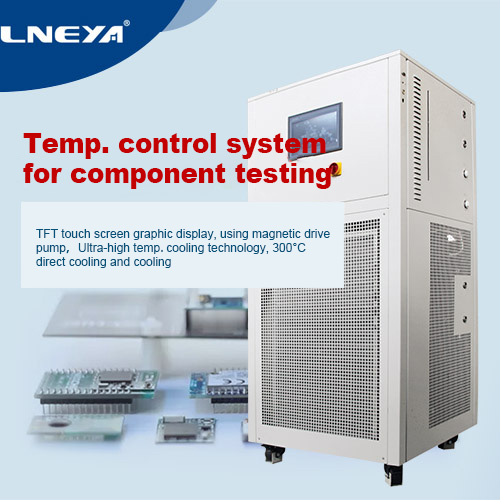
LNEYA semiconductor test chiller adopts advanced liquid temperature control technology, actively explores and studies component test system, mainly used for temperature test simulation in semiconductor test, with wide temperature orientation and high temperature rise and fall, temperature range is -92°C ~ 250°C, suitable for various testing requirements, solving the problem of temperature control lag in electronic components. The ultra-high temperature cooling technology can directly cool from 300°C.
Related recommendations
-
You Know What Technical Problems You Need to Know before You Buy A Low Temperature Chamber
1662Question 1: Is the temperature change rate of temperature impact test the faster the better? Explanation: Is the temperature change rate faster and better in the temperature impact test? Does the temperature change rate have any effect on the tes...
View details -
Reasons for the decrease of heat transfer effect of vertical ultra-low temperature refrigerator
2267If the outer frost layer of the vertical ultra-low temperature refrigerator is too thick or excessively dusty, it can be caused because the external temperature of the evaporator is mostly lower than 0 °C, resulting in low heat transfer efficiency...
View details -
How to solve the lack of cooling capacity of the semiconductor cooling cycle system?
2053The semiconductor cooling cycle system is a device for cooling the heating part of the semiconductor in the refrigeration equipment. It is commonly used to test semiconductor IC parts, automotive electronic parts, optical fiber components, telecom...
View details -
Precautions for safe use of heat transfer oil temperature control equipment
1996With the extensive use of thermal oil temperature control equipment, the safe use of thermal oil temperature control equipment is a concern for users. For manufacturers, it is very important to share the precautions for the use of thermal oil temp...
View details